


First, separate the confirmed model from the imagined workflow
Gemini 4 Argon is not an unverified name: Google’s Gemini API model catalog lists it as a stable model, with the endpoint name gemini-4-argon. That confirms the model’s identity and listed availability; it does not establish that Google built a Shopify store-makeover product, or that OCTOshopX uses Argon. This article treats “Gemini 4 Argon and Shopify” as a future-workflow concept, not an announced integration or product feature. [1]
That distinction matters for merchants. A model listing tells you what Google makes available through its platform, not what a particular Shopify app has implemented, tested, or released. OCTOshopX is a planned Shopify Product & Blog Studio. Its intended workflow can be discussed as a proposal, but it is not available to install or check out today, and no benchmark or product outcome is being claimed.
- Confirmed: Google lists Gemini 4 Argon as stable and names its API endpoint. [1]
- Not confirmed: any direct Gemini 4 Argon–Shopify connection or OCTOshopX integration.
Start with the merchant’s real catalog facts
A useful makeover begins with evidence, not a grand prompt. A ceramic mug seller, for example, should gather the actual capacity, material, dimensions, care instructions, color options, shipping constraints, and product photographs before drafting copy. Those details can guide a more complete product page without inventing dishwasher safety or describing a glaze as handmade when the merchant has not verified that claim.
Shopify already offers AI support in its admin: Sidekick can generate product descriptions and blog posts, and Shopify warns that AI output can contain errors and should be reviewed before changes are applied. [2] A future OCTOshopX workflow is planned around the merchant’s real product facts and photos, but it should not be described as a substitute for verification or as a live feature. The merchant remains responsible for checking claims, policies, and image rights.
- Use a source-of-truth sheet for specifications, approved claims, and exclusions.
- Flag missing details for the merchant instead of letting a writing system fill gaps with guesses.
Make a controlled batch, not a catalog-wide rewrite
Imagine a shop with ten seasonal candles. Rather than rewrite every listing at once, a controlled batch would let the owner select one to ten products, supply the same factual brief, and compare results for consistency. A citrus candle might need clearer scent notes, while a cedar candle needs a different description; shared format does not mean identical language.
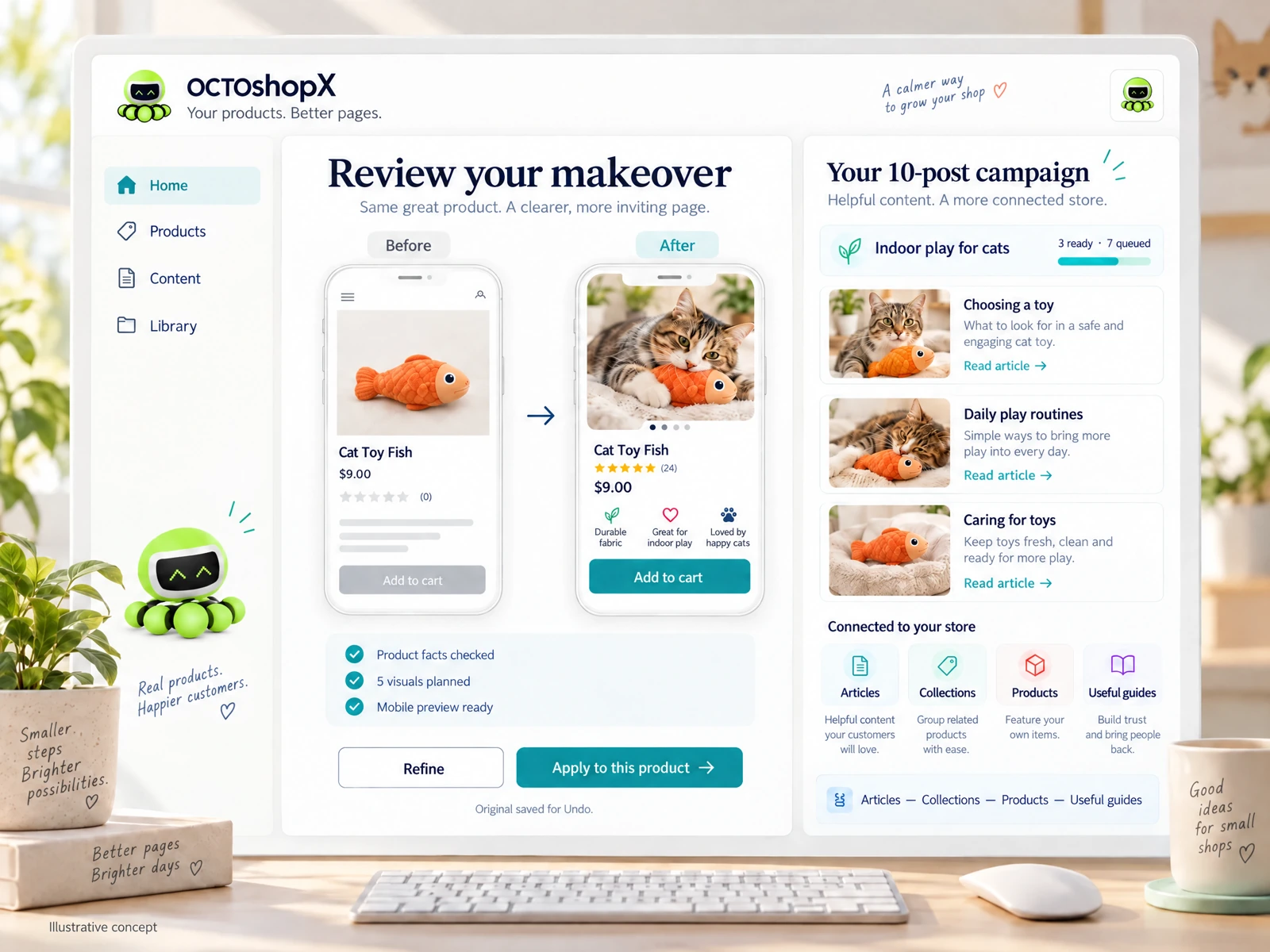
OCTOshopX is planned to support product batches of one to ten, with review before application and an Undo path. These are intended product requirements, not verified capabilities merchants can use now. Keeping the approval step explicit is valuable in principle: the store owner can inspect each description, correct unsupported superlatives, and decide whether the revision fits the brand before changing a live listing.
- Pilot a small group of representative products before planning a wider content refresh.
- Review factual accuracy, tone, variant details, and search usefulness item by item.
Treat product imagery as an editing task with guardrails
A retailer with a plain photo of a linen tote might want a second lifestyle scene for a campaign, while preserving the tote’s real shape, color, straps, and scale. Shopify’s file-editor media generation can transform an image with prompts, replace its background, and extend backgrounds; the documentation describes image editing rather than a complete, automatically produced set of campaign assets. [3] Its documentation also says generated images receive an invisible watermark and advises using images merchants have rights to use. [3]
OCTOshopX’s planned concept calls for five to ten useful visuals and a mobile preview. The practical standard should be relevance rather than volume: a clear primary product view, a detail crop, an in-context scene, and a mobile-friendly crop may serve shoppers better than ten near-duplicates. Previewing on a phone helps catch tiny labels, awkward crops, and backgrounds that obscure the item. These visuals and preview controls remain planned, not released.
- Keep reference photos faithful to the actual product and avoid implying unverified features.
- Check image rights, mobile crops, text legibility, and consistency across variants.
Read the connected-content guide or explore product and blog specimens.
Connect the product page to useful editorial content
A makeover should help a shopper decide, not just decorate a listing. The tote shop could publish a care guide explaining how to clean the fabric, a comparison article for bag sizes, and a packing guide that links readers to the relevant product. Each post should answer a genuine customer question, include accurate details, and offer a clear next step rather than repeating the product title unnaturally.
OCTOshopX is planned to support up to ten posts per campaign and a Shop the Post relationship, alongside an Articles—Collections—Products—Useful guides content structure. Those are roadmap concepts, not an available publishing integration. Shopify’s Sidekick already supports blog-post generation, but merchants should still check facts and editorial quality before publication. [2] The goal of a future workflow would be to organize helpful content around a product, not promise rankings, traffic, or sales.
- Build articles around real use cases, care questions, comparisons, or buying guidance.
- Link products where they genuinely answer the reader’s need; avoid filler posts made only to hit a count.
Choose the right current tool—and budget honestly
Shopify’s current Sidekick and admin AI features are the relevant baseline, not a presumed Argon-powered Shopify feature. Shopify says Sidekick is included with a Shopify plan, while features and usage limits vary by plan. Its AI tools include content drafting and certain media-editing tasks; availability and behavior depend on the specific tool. [2] [3] A merchant can compare those capabilities with their needs now, without waiting for or assuming a new integration.
OCTOshopX’s reference MSRP is $599 for one store or $997 for up to ten stores, including one year of updates and support; optional annual renewal is $79 or $149 respectively. A temporary cash sale, if offered, is $399.90 or $699. These figures are reference pricing, not a currently available checkout. AI plans and selected image or API services cost separately, so no perpetual-free-AI or guaranteed $0 total-cost claim is appropriate. OCTOshoutX is upcoming only: its planned direction includes 9:16 UGC/product video and 48 kHz audio, with optional own hardware and own budget; virality and total cost are not guaranteed.
- Compare actual included features and usage limits before choosing a tool.
- Budget separately for third-party AI plans and image or API services when applicable.
Is Gemini 4 Argon real, and is it connected to Shopify?
Google’s official Gemini API catalog lists Gemini 4 Argon as a stable model, with endpoint gemini-4-argon. [1] That verifies the model, not a direct Shopify integration. No Argon-to-Shopify integration or OCTOshopX use of Argon is confirmed here.
What can Shopify merchants use today?
Shopify documents Sidekick for guidance, content generation, and tasks in the admin, including product descriptions and blog posts. It also documents AI media editing, such as changing image backgrounds or transforming an image with a prompt. Features, plan availability, and usage limits vary, and Shopify advises reviewing AI outputs. [2] [3]
Can I install OCTOshopX or buy the planned license now?
No. OCTOshopX is a planned Shopify Product & Blog Studio, and installer and checkout are unavailable. Its listed prices are reference MSRP, not an active offer. AI plans and selected image or API services are separate costs; OCTOshopX is not represented as proven, released, or benchmarked.
Sources & comparison notes
Provider-described features and prices can change. Check the linked sources and purchase terms before choosing a service.
- Models | Gemini API | Google AI for Developers · checked 2026-10-17
- AI-powered tools | Shopify Help Center · checked 2026-10-17
- Media generation in the file editor | Shopify Help Center · checked 2026-10-17
Install OCTOshopX. Give your store one clear job.
Gemini 4 Argon is confirmed in Google’s model catalog, but a Shopify integration is not. Merchants can use Shopify’s documented AI tools today while keeping a human review between generated content and live store changes. OCTOshopX remains a planned concept with separate service costs and no installer or checkout available. Install OCTOshopX.
A calm Shopify Product & Blog Studio: 5–10 useful visuals, connected articles and products, preview before publishing, and 1-Click Undo when needed.