


Why the 2025 Moment Matters for 2026 Planning
The year 2025 saw rapid adoption of AI-assisted content tools that changed how merchants approached keyword research, topic clustering, and on-page drafting. For store owners updating plans in 2026, treating 2025 as a pivot year helps preserve useful search phrases and intent signals while acknowledging newer behavior shifts.
Merchants should map what worked in 2025 — strong topical authority pages, product-guided articles, and consistent schema use — and then layer 2026 realities on top: higher expectations for factual consistency, clearer visual layouts, and attention to interactive product content. This hybrid approach prevents throwing out proven practices that still affect rankings and conversions.
- Keep historical 2025 keywords but re-evaluate intent before republishing
- Use 2025 as baseline, add 2026 adjustments for accuracy and layout
- Focus on shopper intent over single keyword density
Content Planning with 'wordpress seo content strategy ai 2025' in Mind
When you plan content, anchor a cluster around the legacy phrase wordpress seo content strategy ai 2025 only if it matches current user intent. For merchants, that usually means creating a hub page that explains historical change, actionable takeaways, and concrete product-related outcomes — for example, how a given tool or workflow affected product discoverability in 2025.
Avoid creating pages that exist solely to chase that exact phrase. Instead, blend it into topical guides that cover product pages, buying guides, and comparison articles. This respects the keyword's search history while offering useful, shop-relevant content that customers actually read and use.
- Create a hub article that contextualizes 2025 changes for shoppers
- Use the phrase naturally in headers and summaries, not as the sole focus
- Connect hub pages to related product and category pages
Drafting and Reviewing AI-Assisted Copy
AI tools can speed initial drafts for descriptions, FAQs, and blog posts, but merchants must layer human review for accuracy, style, and brand voice. For legacy topics like 2025 changes, fact-check timelines, avoid overstating impact, and ensure product links and comparisons reflect your own inventory and policies.
Practical workflow: generate a first draft, highlight claims about 2025 behavior, verify against your site analytics or screenshots, then rewrite sections where AI generalized or hallucinated. Keep revision passes short and objective-focused — clarity, accuracy, and conversion utility.
- Use AI for first drafts; always fact-check and localize
- Mark historical claims for human verification
- Edit with conversion goals in mind (CTAs, product links, microcopy)
Design, Layout, and Internal Linking for Merchant Pages
A generic connection between systems or a basic content upload does not guarantee faithful visuals or useful internal links. Merchants need to check that headings, product callouts, and reviews display cleanly on mobile and desktop before publishing. Make sure product pages linked from legacy guides maintain consistent imagery and up-to-date prices.
Improve engagement by adding concise comparison tables, short how-to video clips, and clear 'buy' or 'learn more' links to related categories. These layout choices help search engines understand page purpose and help shoppers move toward buying decisions.
- Preview pages on multiple devices to ensure layout fidelity
- Add clear internal links from legacy guides to current products
- Include short visual elements to increase time on page
Read the connected-content guide or explore product and blog specimens.
Measuring Outcomes and Iterating
Track simple, merchant-focused KPIs after republishing legacy content: click-throughs to product pages, add-to-carts from guide links, and time on page for your hub articles. Avoid overreliance on AI-generated traffic predictions; let real visitor behavior guide the next edits.
Set a short iteration cadence (30–60 days) to update claims, refresh visuals, and test alternative CTAs. If a page referencing wordpress seo content strategy ai 2025 draws visitors but few buyers, refine links, add clearer product tie-ins, or convert part of the article into shorter, product-focused snippets.
- Monitor product click-throughs and add-to-cart rates from legacy guides
- Iterate on CTAs within 30–60 days based on behavior
- Use A/B tests for headlines or link wording where possible
Practical Workflows and Example Tasks for Small Shops
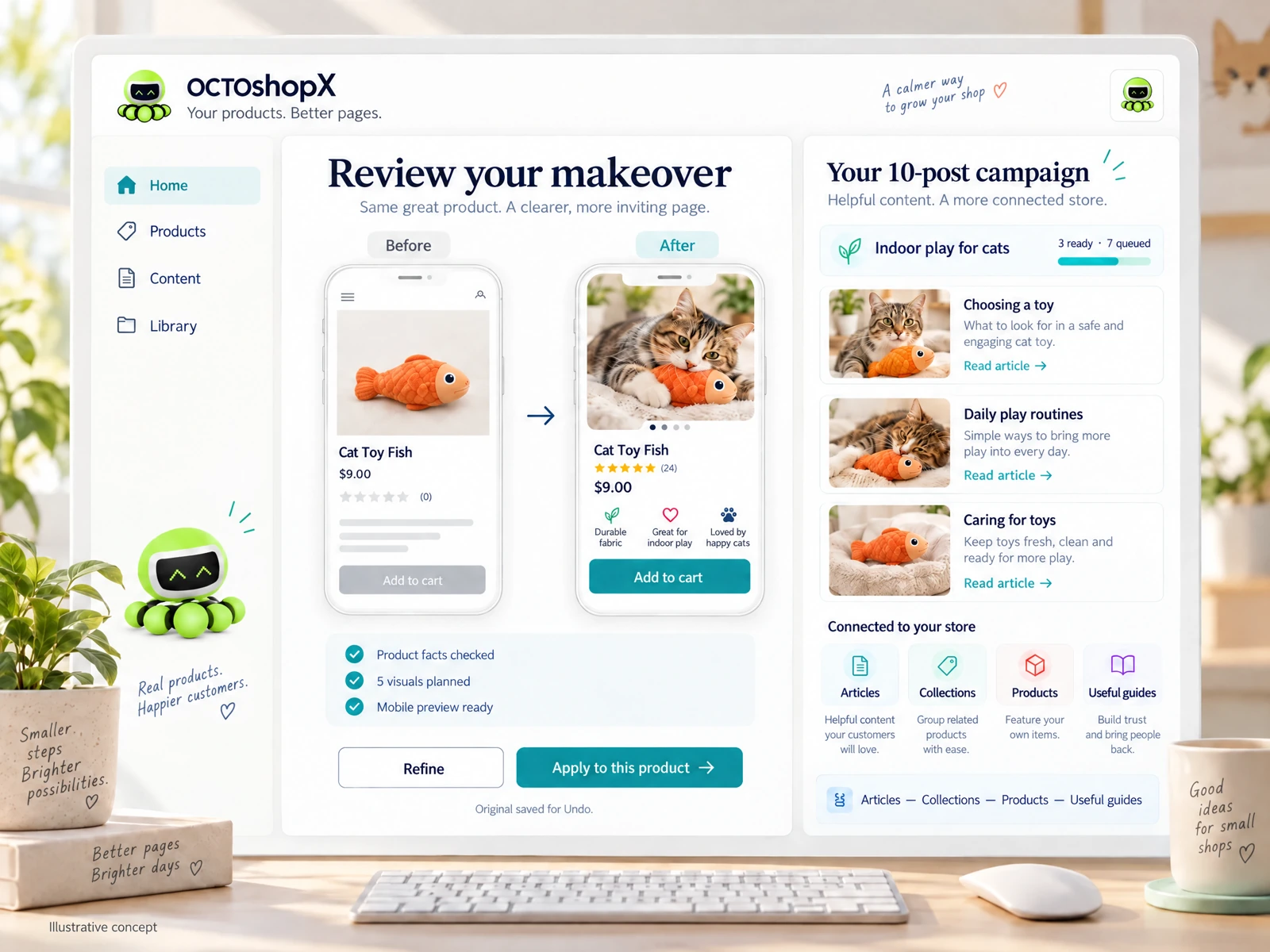
Example workflow: pick a single legacy topic page, run a focused AI draft for structure, manually verify historical points, connect three product links, preview on mobile, then publish with a small promotion in your newsletter. Limit scope to 1–10 products per campaign to keep quality high and measurable.
Another task list: update product schema snippets on related pages, add a short 'What changed in 2025' box near the top of the article, and write two short product-focused blog posts (up to ten posts per campaign if you prefer) that expand on specific items mentioned in the hub. These are practical, repeatable steps that align with merchant resources and attention.
- Run one hub update per campaign with linked product pages (1–10 items)
- Preview before applying changes; keep originals for undo
- Produce a small set of product-focused posts to support the hub
Should I optimize a product page specifically for the phrase 'wordpress seo content strategy ai 2025'?
Not usually. Use the phrase in a contextual hub or historical overview where it fits naturally. Product pages should target transactional intent and specific product features; link from the hub to product pages rather than forcing the legacy phrase into product titles.
How much can I rely on AI to update legacy content about 2025?
AI is useful for drafting structure and copy economy, but you must verify historical claims, dates, and product-related facts. Treat AI drafts as a starting point and use short human review passes focused on accuracy and conversion.
What metrics tell me if a 2025-focused page is helping sales?
Watch product click-through rate from the page, add-to-cart rate for linked products, and assisted conversions over 30–60 days. If traffic rises but sales do not, refine CTAs, link prominence, and on-page product details.
Install OCTOshopX. Give your store one clear job.
Use 2025 as a practical historical layer: keep what worked, fix what didn’t, and prioritize clear product connections and verification. Install OCTOshopX.
A calm Shopify Product & Blog Studio: 5–10 useful visuals, connected articles and products, preview before publishing, and 1-Click Undo when needed.